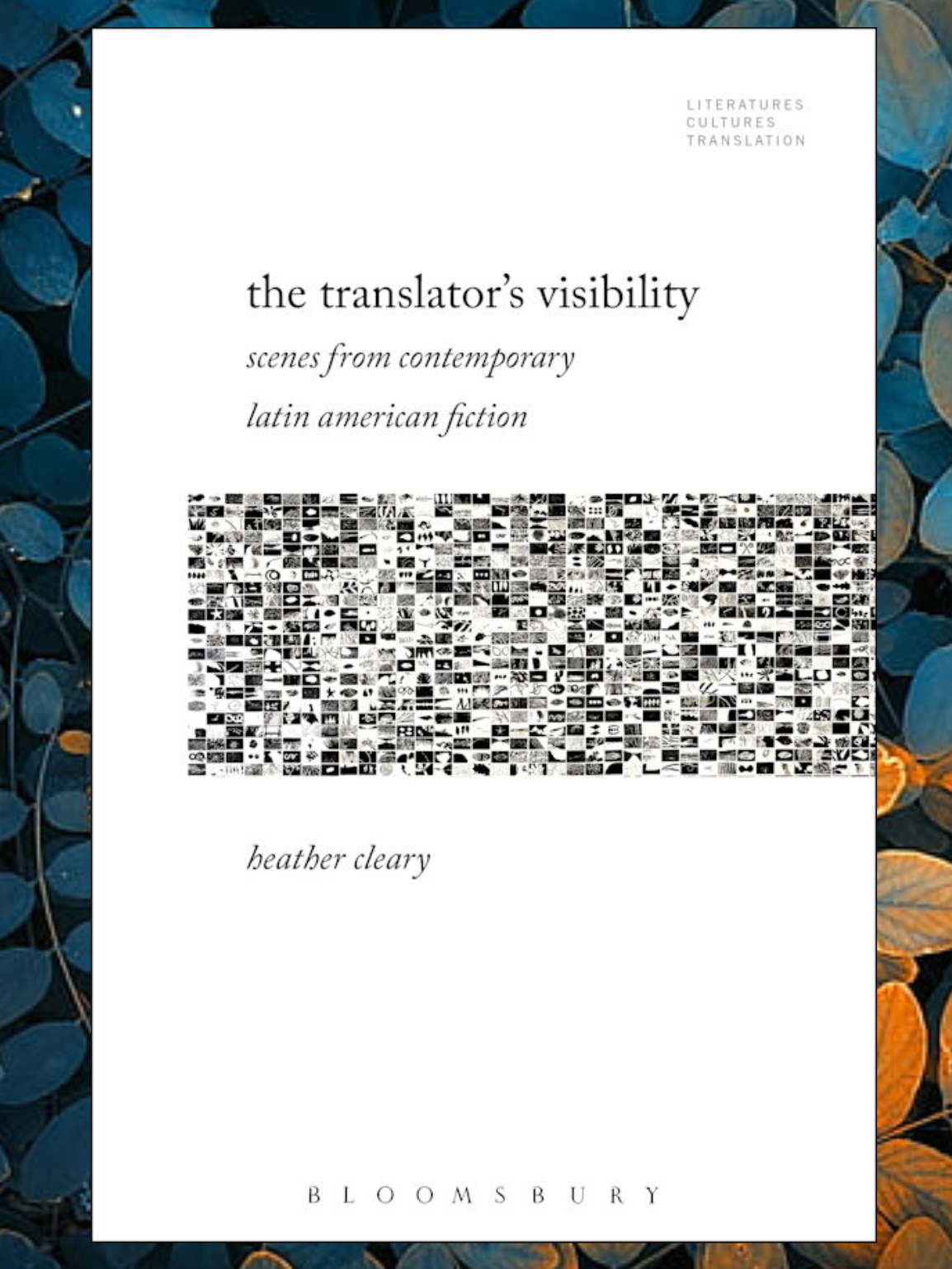
Through close readings of contemporary novels that foreground translation by writers like Cristina Rivera Garza, César Aira, Valeria Luiselli, and Luis Fernando Verissimo, The Translator’s Visibility shows how the narrative mobilization of translation theory is able to challenge the strictures of intellectual property and propriety, unseating the original text as a privileged repository of meaning.
In this way, translation not only serves to renew national literatures through an exchange of ideas and forms; when rendered visible, it also can help us reimagine the terms according to which those exchanges take place.
Here’s what a few admired colleagues say about The Translator’s Visibility:
“Cleary’s lucid, illuminating and strikingly original study […] will be a model for critics in years to come.”
– Jacques Lezra, Professor and Chair, Hispanic Studies, University of California at Riverside
“In her up-to-the-minute investigation of translation as it is foregrounded in recent Latin American fictions, Heather Cleary, herself a remarkable translator, apprehends a rather savage array of louche conducts, among them the dismantlement of the author, the disruption, interruption, corruption, and rupture of systems of intellectual property, the resistance to intelligibility, and the parasitic undermining of legitimacy. Obviously very much at home in this seditious underworld, Cleary provides a lucid and celebratory guide to its denizens, the unreliable narrators and translators, pseudo-originals, pseudo-translations, marginalia, prefaces, afterwords, and (especially) footnotes that conspire to overturn the world literary order in general, and in particular the weary tenets that translation is separate from writing, and fiction is separate from theory.”
– Esther Allen, Professor, Modern Languages and Comparative Literature, Baruch College
“The margins in my copy of The Translator’s Invisibility are full of scribbled praise for Cleary’s sparkling sentences and the ideas they unfold about how translation, as both practice and trope, upends the demands of property and propriety nested in the concept of propriedad intelectual, and about how fictional texts featuring translator-protagonists can help shape new understandings of the always collaborative, sometimes contested activity that authorship always is. Cleary’s readings of the novels she examines are brilliant; her reworking of the concept of untranslatability—which moves it away from the ‘economy of equivalence’—extremely welcome; and her writing full of humor and panache. The Translator’s Visibility is a book I’ll be recommending, returning to, and teaching with for years to come.”
– Karen Emmerich, Associate Professor of Comparative Literature, Princeton University
“Heather Cleary’s contribution to the Fictional Turn in translation studies pushes the conversation on Latin America’s critical and creative engagement with translation to new and exciting extremes, with a socioeconomically grounded focus on ‘the asymmetries of discursive authority, the conditions under which cultural goods circulate, and the persistent dichotomy between the so-called “creative” traditions of the metropolis and derivative “translating” cultures at the periphery.’ Transformative scholarship; highly recommended.”
– Douglas Robinson, Professor of Translating and Interpreting, Chinese University of Hong Kong
Available now from Bloomsbury.

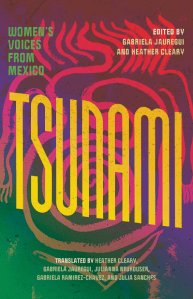 Tsunami
Co-edited with Gabriela Jauregui (Feminist Press 2025)
Featuring personal essay, manifesto, creative nonfiction, and poetry, Tsunami gathers the multiplicity of voices being raised in Mexico today against patriarchy and its buried structures. Tackling gender violence, community building, #MeToo, Indigenous rights, and more, these writings rock the core of what we know feminism to be, dismantling its Eurocentric roots and directing its critical thrust towards current affairs in Mexico today. Asserting plurality as a political priority, Tsunami includes trans voices, Indigenous voices, Afro-Latinx voices, voices from within and outside academic institutions, and voices spanning generations.
“Tsunami is a shock to the system, a seismic disturbance unsettling our narratives about the injustices women endure and the structures that enable them. Through these essays which scream against mass murder of women, challenge the erasure of indigenous struggle, and morph the oppressive norms hidden in our language, an alternate reality is already born.” — Miriam Toews, author of Women Talking
Contributors include Marina Azahua, Yásnaya Elena Aguilar Gil, Dahlia de la Cerda, Lia García, Jimena González, Fernanda Latani M. Bravo, Valeria Luiselli, Ytzel Maya, Brenda Navarro, Jumko Ogata, Daniela Rea, Cristina Rivera Garza, Diana J. Torres, Sara Uribe, and the Zapatista Army for National Liberation, with translations by Julia Sanches, Gabriela Ramirez-Chavez, Julianna Neuhouser, Heather Cleary, and Gabriela Jauregui.
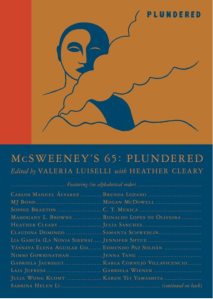 McSweeney’s 65: Plundered
Co-edited with Valeria Luiselli (2021)
Plundered spans the American continent, from a bone-strewn Peruvian desert to inland South Texas to the streets of Mexico City, and considers the violence that shaped it. In fifteen bracing stories, the collection delves into extraction, exploitation, and defiance. How does a community, an individual, resist the plundering of land and peoples?
A sweeping portrait of a hemisphere on fire, Plundered brings together stories of stolen artifacts and endless job searches, of nationality-themed amusement parks and cultish banana plantations and features contributors from Brazil, Cuba, Bolivia, Mexico, Argentina, Ecuador, the United States, and elsewhere.
Contributors include Karen Tei Yamashita and Ronaldo Lopes de Oliveira, Gabriela Wiener, Laia Jufresa, Carlos Manuel Álvarez, Sophie Braxton, Gabriela Jauregui, Julia Wong Kcomt, Brenda Lozano, Mahogany L. Browne, Samanta Schweblin, Sabrina Helen Li, Edmundo Paz Soldán, Nimmi Gowrinathan, MJ Bond, and C. T. Mexica, with translations by Heather Cleary, Gabriela Jauregui, Megan McDowell, Julia Sanches, Jennifer Shyue, and Jenna Tang.

My columns on literature in translation for LitHub’s BookMarks are available here.
“Playing With Words” Literary Hub 2023
“Write Like a Translator” Poets & Writers 2023
“In Bad Faith: Notes on Fidelity in Translation” Poets & Writers 2023
“Playing with Words” Literary Hub 2023
“In Memoriam: Sergio Chejfec” Literary Hub 2022
“Close Listening: A Playlist for American Delirium” Words Without Borders 2021
“Collaboration” for Two Lines 30: The Future of Translation Two Lines 2019
“There’s No Place Like Home (Including Home Itself)” (Interview with Samanta Schweblin) LitHub 2019
“The Secret Bookstores of Buenos Aires” LitHub 2016
“Canadian Gothic: On Samuel Archibald’s Arvida” Three Percent BTBA Judges Blog 2016
“On Fiston Mwanza Mujila’s Tram 83” Three Percent BTBA Judges Blog 2016
“On Yuri Herrera’s Signs Preceding the End of the World“ Three Percent BTBA Judges Blog 2016
“On Yoel Hoffman’s Moods” Three Percent BTBA Judges Blog 2015
“Beyond Borges: 5 Argentine Writers You Should Know” Literary Hub 2015
“Mario Bellatin’s Jacob the Mutant” Music & Literature 2015
“Mario Bellatin’s Shiki Nagaoka: A Nose for Fiction” Words Without Borders 2013
“Carlos Fuentes’s Vlad” Words Without Borders 2012
“The Geometry of Dissent: on the novels of Juan José Saer” The Quarterly Conversation 2012
“César Aira’s Varamo“ Words Without Borders 2012
“Sergio Chejfec’s My Two Worlds“ Big Other 2011
“César Aira’s The Literary Conference“ Big Other 2010
 Heather Cleary